Business Brain

Your company finally has a brain.

Every company generates information.
Few companies can hold it together.

How the Business Brain holds that information together.

01 · Information

Companies generate information every day.

Customers. Email. Documents. Meetings. Tasks. People. Data. Applications.
Work keeps creating more information.

  • Customers
  • Email
  • Documents
  • Meetings
  • Tasks
  • People
  • Data
  • Applications

The question is not whether information exists.
The question is whether the company can hold it.
02 · Fragmentation

That information is scattered.

Every software knows only a small part.
The CRM knows the deal.
The inbox knows the thread.
The calendar knows the meeting.

No system knows the company.

Context breaks between tools. Teams remake the same decisions. People fill gaps from memory — until they cannot.

03 · Business Brain

Then the Business Brain enters.

It does more than store data.
It builds context and connects people, work, and history.

  • Understands

    It surfaces what matters — not only what was filed.

  • Builds context

    People, deals, documents, and history stay connected.

  • Remembers

    What was decided does not disappear into a thread.

  • Learns

    New information improves the next answer.

What changes

The company stops losing context between tools.

Next: one customer request, end to end.

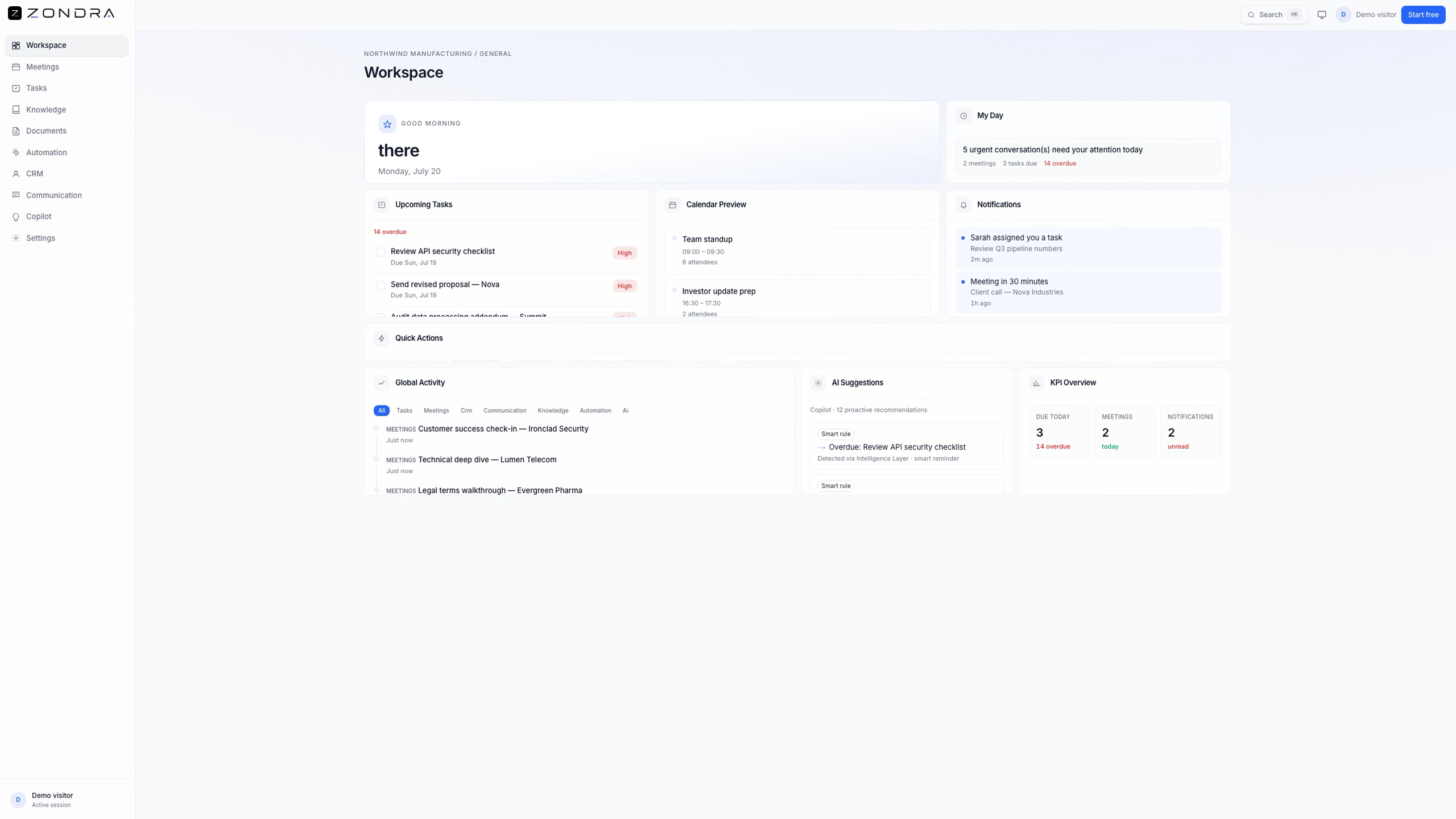
Guided demo

Watch the Business Brain work.

One customer request.
Systems connect. Context forms. A decision is prepared.

Step 1 of 9

Incoming request01 / 09

Customer request

Elena Park asks to accelerate the Acme Corp renewal review.

Not a feature tour.
The operating mind of the company — observed.

04 · Decisions

Understanding becomes decisions.

From context, the Business Brain surfaces what needs attention.
Suggestions appear with evidence.
People stay in control.

  • Prepare tomorrow's meeting with Acme.
  • Which customers need attention today?
  • Create follow-up tasks from today's meeting.
  • What changed this week?
  • Generate follow-up email.
  • Show blocked work.

Copilot

Acme Corp · shared context

Prepare tomorrow's meeting with Acme.

Ready for Acme — QBR prep

  • Summary · Renewal in Negotiation. Last meeting closed three open risks.
  • Open tasks · Send revised SOW · Confirm privacy clauses · Align on seats
  • Recent email · Elena asked for pricing options by Friday
  • Latest proposal · Nova-style MSA template, v3 attached in Documents
  • Risks · No contact in 5 days · Champion traveling until Thursday
  • Agenda · 1. Pipeline status 2. Contract gaps 3. Next actions
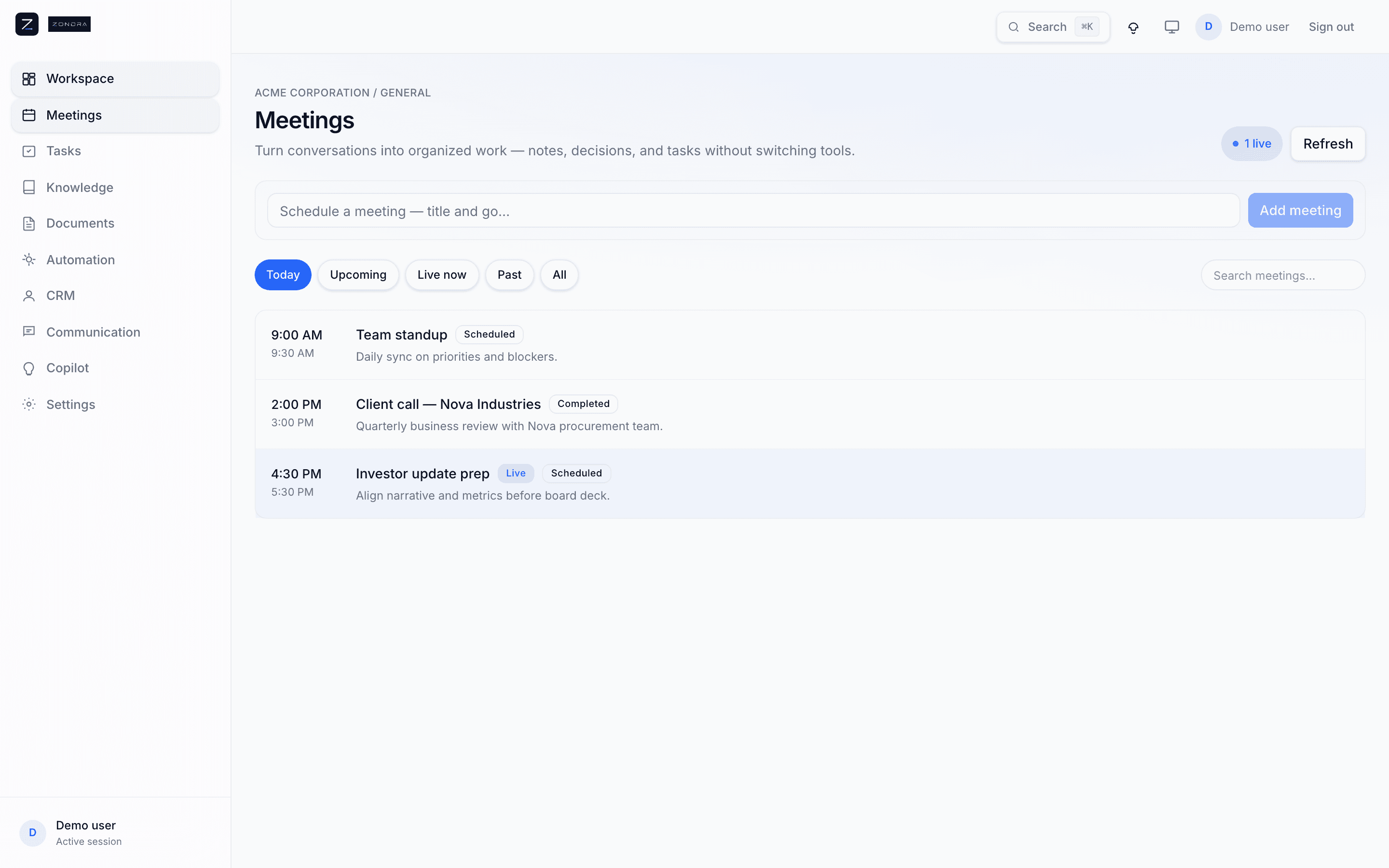
Zondra Meetings — agenda and follow-ups Copilot draws from

04 · Automation

Decisions prepare what happens next.

Automations are ready when the context is ready.
People remain in control.

  1. 01

    Context arrives

    A reply, meeting, or document lands in company context.

  2. 02

    Meaning is read

    Decisions and next steps become visible.

  3. 03

    Work is prepared

    Follow-ups are prepared for review.

  4. 04

    People approve

    Humans keep the final say.

  5. 05

    Action continues

    The next step inherits the same context.

05 · Results

The company gets clearer over time.

Every new piece of information improves the Business Brain.
Every decision improves the next one.

  1. Information
  2. Understanding
  3. Context
  4. Decisions
  5. Automation
  6. Results

Information → understanding → context → decisions → automation → results.
That is how the company works with a Business Brain.

The difference

Now you know why Zondra is different.

Because it has a Business Brain.

  • Not a CRM

    A CRM tracks relationships. The Business Brain connects them to work, memory, and decisions.

  • Not back-office software

    Operational systems record transactions. The Business Brain keeps the meaning behind them.

  • Not a workspace

    A workspace organizes tasks and files. The Business Brain gives the company shared context.

Security the company can trust.

The Business Brain holds company knowledge. Security is built in — not an add-on.

  • Encryption

    Data protected in transit and at rest — on by default.

  • Audit Logs

    Know who changed what, and when.

  • Role Permissions

    Each team sees what it needs — and nothing it should not.

  • Google Workspace

    Connect Gmail and Calendar so conversations and events live in company context.

  • Microsoft

    Bring Microsoft 365 mail and calendar into the same Business Brain.

  • Data Protection

    Privacy controls and retention you can configure.

FAQ

Answers about Zondra and the Business Brain.

What is Zondra?

Zondra is the Business Brain for your company. It holds information, builds context, supports decisions, and prepares the next action.

Is Zondra a CRM or a workspace?

No. Those tools store parts of the work. Zondra connects people, data, documents, decisions, and actions in one Business Brain.

Who is it for?

CEOs, founders, and managers who need shared company context — and teams in consulting, agencies, sales, and professional services.

What is available now?

Closed Alpha includes the Business Brain and Google Workspace integrations. More agents are planned.

Give the company
a Business Brain.

Information. Understanding. Context. Decisions. Automation. Results.
Start when you are ready.